
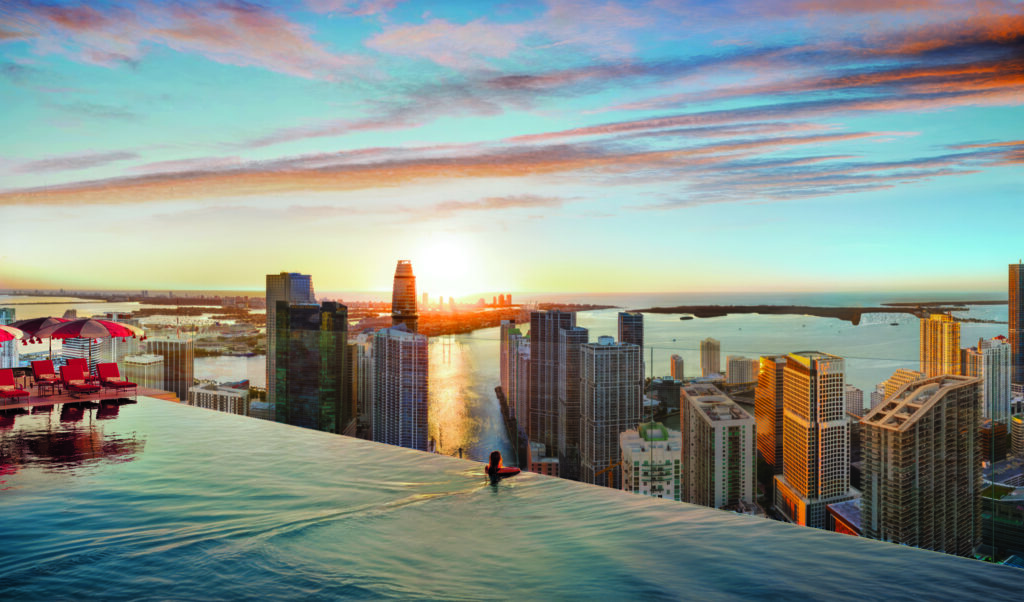
Brickell is in the middle of a branded residence boom, with names running from Cipriani to Mandarin Oriental to Mercedes-Benz building within a few miles of one another. The standard across them runs deep enough that choosing between buildings is rarely a matter of choosing between good and better. Floor-to-ceiling glass, a pool deck held above the skyline, an interior designer with an international portfolio, a wellness floor given over to heat and water, and quiet. Once the specifications match across a neighborhood, the choice stops being about the building and starts being about who is behind it.
The name on the building is the shortest answer available, which is why branded residences in Miami have become the prevailing form of new luxury development rather than a niche within it. If you are weighing one branded address against another, the measure that matters is not prestige but obligation. A name attached to a residential building is a commitment to how it will be run and by whom, made in public and measurable against everything else that name has built.
How Branded Residences Became Miami’s Default Luxury Product
The category has grown quickly enough to change the shape of the market it sits in. Savills, the global property advisory firm, counts roughly 910 branded residential schemes worldwide at the close of 2025, up from 764 a year earlier, a rise of 19% in a single year, with twenty-five countries recording their first branded residential project in that period alone.
The premium these buildings command is often mistaken for the price of the name itself. Savills puts that premium at 33% on average worldwide, and at 30% in established and emerging city markets. What it purchases is less visible and considerably more useful. A service infrastructure arrives funded and staffed from the first day of occupancy rather than assembled by committee in the years after. An authorship stays attached to the building, verifiable by whoever comes next. A standard is held by people whose reputation depends daily on holding it.
Miami’s density within the category has changed what a name is now required to prove. With Cipriani, Mandarin Oriental, Dolce & Gabbana, Mercedes-Benz, and Nobu all rising within a few miles of one another, the presence of a name distinguishes nothing on its own. What distinguishes it is the particular promise beneath it, and whether the brand making that promise has ever run a place where people live rather than visit.
What Five-Star Service Looks Like in a Branded Residence
Service is the least photographable element of a residence and the one you meet most often. It shows in whether a request made once is remembered without being made again, in the hour a delivery is expected to arrive, and in the tone of the person at the desk at any given moment.
A hotel brand entering residential development arrives with the apparatus already assembled: hiring standards, training, an escalation path, and a reputation exposed every day to the consequence of failing any of them. Forbes Travel Guide inspectors test properties against up to 900 standards while posing as ordinary guests, and roughly 70% of a rating rests on service alone. The building is measured against the brand’s existing properties, which means you can walk into one long before you buy and see for yourself what is being offered.
Faena Residences Miami is served by the same culture that runs the brand’s hotel across the bay. Faena Hotel Miami Beach holds the Forbes Travel Guide Five-Star rating and has held it consecutively for years, appearing again among the Five-Star hotels in the 2026 Star Awards. Within the residences, that same standard becomes a fully serviced home, with staffed guardhouses, a riverfront porte cochère, marine concierge programming for those arriving by water, and a team whose work is to anticipate rather than to wait to be asked.
What It Means When a Branded Residence Names Its Architects

The design of a branded residence is rarely the work of one hand. Architecture, interiors, and landscape go to separate studios, and the character of the finished building comes from how well those decisions were made in the same room.
At Faena Residences Miami the architecture belongs to Rafael Viñoly Architects and stands among the last works of Viñoly’s career, a fact that will read differently with every year that passes. Interiors come from Faena Design in collaboration with Bryan O’Sullivan Studio, the AD100 firm with offices in London and New York whose rooms are known for holding warmth alongside restraint, and the landscape is the work of Sasaki. The decision that shapes everything else is structural. Two 68-story towers rise from the riverfront and are joined 700 feet in the air by a 45,000-square-foot Sky Bridge, an arrangement that determines the silhouette read from the water and, more quietly, the way you move between your own door and everything else the building holds.
The Brands That Build Neighborhoods Rather Than Buildings
The distinction worth drawing within the branded residences category is between a name licensed to a developer and a name that has spent decades operating places where people gather and stay. Faena belongs to the second kind, and the history behind it is specific rather than atmospheric.
Alan Faena’s first district took shape in Puerto Madero in Buenos Aires. The Miami Beach district followed at Collins and 34th, in a stretch of Mid-Beach that was relatively unknown at the time, anchored by a hotel that opened in December 2015 inside the former Saxony. Both began from the same conviction, which is that a building behaves differently when culture is drawn into it at the outset rather than added once the doors open. The through line matters if you are evaluating Faena Residences Miami, because the same hands are now at work along the Miami River, with Fortune International Group and KAR Properties as co-developers.
Where Faena Residences Miami Sits in the Brickell Market
The project sits within the fourteen-acre Faena District Miami River along 327 feet of private river frontage in Brickell, held as a gated riverfront enclave behind landscaped gardens, a staffed guardhouse, and its own access to the water.. Residences run from one to four bedrooms, with River Lofts at the water’s edge, Sky Lofts higher in the towers, and full-floor penthouses at the crown. Each arrives fully finished, travertine underfoot through the living spaces, custom Italian cabinetry, stone counters and baths, appliances by Gaggenau.
What separates the address from most of its Brickell peers is the ground beneath it. A gated enclave with river frontage of its own is a rare arrangement in a neighborhood built vertically and to the lot line, and it produces two rhythms within a few minutes of each other. On one side of the gate, the water keeps its own unhurried time. On the other, Brickell City Centre, the restaurants and waterfront lounges of the neighborhood, and the museums along the bay are close enough to reach on foot when you want them and far enough to forget when you do not.
The Cultural Life That Comes With a Faena Address
The clearest distinction is Faena Rose, the art and culture-based private members community Faena has run since 2016, founded on the principles of art, culture, community, and access. Members are brought together through a year-round calendar of cultural experiences, and the community it has built over a decade is the part that cannot be replicated by a developer assembling an events program from scratch.
Faena Residences Miami will be the first purpose-built home Faena Rose has ever had. The 45,000-square-foot Sky Bridge holds it across three connected levels, with a grand hall, a forty-seat cinema, a gallery, dining rooms, a library lounge, studios for recording and creation, wellness spaces, and a pool deck attended by Faena’s butlers. Access comes with ownership, which is a materially different proposition from a building that keeps a room free for the occasional evening.
What the Faena Name Carries in Miami
A name on a residential building is a promise rather than a badge. At Faena Residences Miami, that promise is visible in three places. The service culture comes from a hotel that has held its Forbes Five-Star rating year after year. The design carries the record of Rafael Viñoly Architects, Bryan O’Sullivan Studio, and Sasaki, all of whose work stands elsewhere in the world and can be walked through. The cultural life belongs to Faena Rose, a members’ community running for a decade before it was given its first purpose-built home. Each of the three can be checked before you buy, which is a useful test to bring to any branded residence in Miami.
By appointment, by inquiry, by introduction. The Faena Residences Miami team welcomes the conversation. To arrange a private tour of the Sales & Design Collaboratory, call 305.424.2055 or inquire.
FAQs
What is a branded residence?
A branded residence is a home in a building operated under the name of a hospitality, design, or luxury house, where the brand carries responsibility for how the property is run rather than licensing its name and stepping away. The practical effect is that staffing, training, and operating standards arrive with the building instead of being assembled by committee in the years after occupancy.
What are the drawbacks of buying a branded residence?
A brand attached to a residential building is only as good as its record of running one. The distinction worth drawing is between a name licensed to a developer and a name that has spent decades operating places where people gather and stay. A brand with no operating history gives you nothing to walk through and test before you buy, which is the most reliable way to check what is being promised.
How many branded residences are there, and how fast is the category growing?
Savills counted roughly 910 branded residential schemes worldwide at the close of 2025, up from 764 a year earlier, a rise of 19% in a single year. Twenty-five countries recorded their first branded residential project in that same period.
Who designed and who is developing Faena Residences Miami?
The architecture belongs to Rafael Viñoly Architects and stands among the last works of Viñoly’s career, with interiors by Bryan O’Sullivan Studio and landscape design by Sasaki. Fortune International Group and KAR Properties are co-developers. Two 68-story riverfront towers are connected by a 45,000 square foot Sky Bridge, an arrangement that shapes both the silhouette read from the water and the way you move between your own door and everything else the building holds.
What does ownership include beyond the residence?
Faena Rose is the cultural institution Faena founded in Miami Beach in 2016, rooted in the principles of cultural enrichment, community, patronage, and access, and built around a year-round calendar of conversations, screenings, performances, and cultural excursions. Faena Residences Miami is the first purpose-built cultural destination Faena Rose has ever had, held across three interconnected levels of the Sky Bridge 700 feet above the river, in a private dimension of Faena life reserved for owners.
Q: Are branded residences the same as condos?
Yes. Branded residences are typically structured as condominiums, so branded luxury condos and branded residences describe the same ownership structure. The difference buyers are actually weighing is not the legal form of ownership but the operating standard behind the name, whether a hospitality brand’s service culture, design record, and staffing arrive with the building or are assembled after the fact.